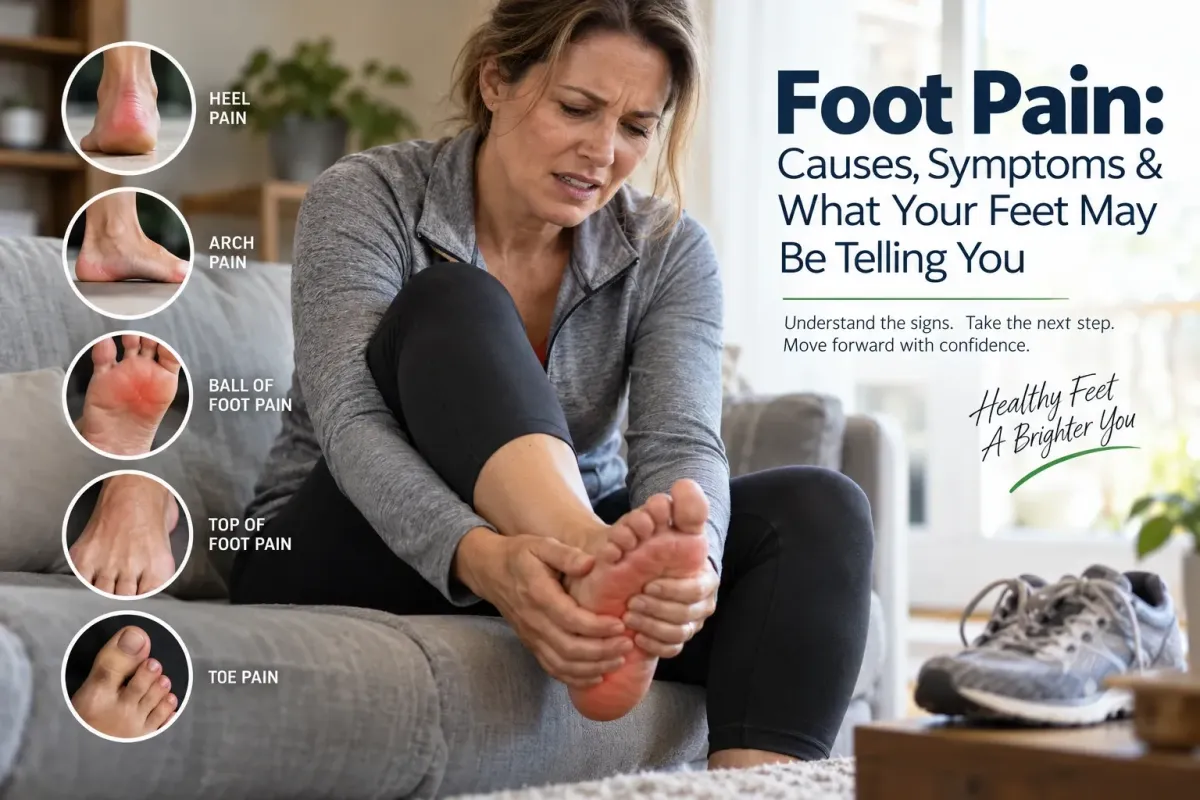
Foot Pain: Causes, Symptoms & What Your Feet May Be Telling You
Foot Pain: Causes, Symptoms & What Your Feet May Be Telling You
Foot pain isn't just one problem.
A sharp pain under your heel when you first get out of bed is different from burning beneath your toes. An aching arch after hours on your feet isn't the same as pain along the outside of your foot.
And that's exactly why simply saying “my feet hurt” doesn't tell the whole story.
Where your foot hurts, when it hurts, what the pain feels like, and what you're doing when it happens can all provide useful clues about what may be contributing to the problem.
At Fix My Feet, we help people throughout Michigan take a closer look at what their feet may be telling them. By considering your symptoms, foot structure, pressure patterns and the way you stand and move, it's possible to better understand whether foot mechanics or inadequate support may be contributing to your discomfort.
The goal isn't to guess at a diagnosis.
It's to better understand what may be happening beneath your feet—and what your next step should be.
Quick Answer: What Can Cause Foot Pain?
Foot pain can have many possible causes, including:
plantar fasciitis
flat feet or fallen arches
high arches
overpronation
supination
bunions
hammertoes
calluses or corns
arthritis
Achilles tendon irritation
Morton’s neuroma
footwear pressure
prolonged standing or walking
overuse
injury
nerve irritation
changes in how pressure is distributed across the foot
The location and pattern of your symptoms can help narrow down the possibilities, but persistent or severe foot pain should be appropriately evaluated.
Start With the Most Important Question: Where Does Your Foot Hurt?
Your feet contain numerous bones, joints, muscles, tendons, ligaments and other structures working together every time you stand or take a step.
That means pain in different areas may point toward very different problems.
Here's a quick guide.
Where You Feel Pain | What It May Feel Like | Possible Causes |
|---|---|---|
Bottom of heel | Sharp, stabbing or tender | Plantar fasciitis, pressure or irritation |
Back of heel | Aching, tight or tender | Achilles tendon irritation |
Arch | Aching, burning, pulling or fatigue | Flat feet, fallen arches, high arches, plantar fascia strain |
Ball of foot | Burning, aching or pressure | Metatarsalgia, Morton’s neuroma, excess forefoot pressure |
Top of foot | Tenderness or pain when walking | Footwear pressure, overuse, tendon irritation |
Outside of foot | Aching or concentrated pressure | Supination, instability, overuse |
Big toe | Joint pain, stiffness or pressure | Bunions, arthritis |
Other toes | Rubbing, pressure or soreness | Hammertoes, corns, footwear pressure |
Entire foot | Tired, sore or heavy | Prolonged standing, activity, footwear or inadequate support |
Burning or tingling | Pins-and-needles or numbness | Nerve irritation or other medical conditions |
Let's look more closely at what each area may be telling you.
Heel Pain: Why Does the Bottom of My Heel Hurt?
Heel pain is one of the most common types of foot discomfort.
When pain occurs beneath the heel—particularly during the first steps after getting out of bed—plantar fasciitis may be one possibility.
The plantar fascia is a strong band of tissue running along the bottom of the foot from the heel toward the toes. It also plays an important role in supporting the arch.
Common signs associated with plantar fasciitis can include:
sharp pain underneath the heel
discomfort during the first few steps in the morning
pain after sitting for an extended period
heel pain after prolonged standing
discomfort that returns after activity
Foot mechanics, activity, footwear and repeated stress may all play a role.
If inadequate support or pressure distribution is contributing, properly selected arch support may help reduce stress on sensitive areas of the foot.
Related Discover Article:
Plantar Fasciitis: Symptoms, Causes & What May Help
Back-of-the-Heel Pain: Could It Be Your Achilles Tendon?
Pain above or behind the heel is different from pain underneath it.
The Achilles tendon connects the calf muscles to the heel and plays a major role in walking, climbing stairs, running and pushing off the ground.
Possible signs of Achilles tendon irritation can include:
pain behind the heel
stiffness
tenderness
discomfort after activity
morning tightness
pain when walking uphill or climbing stairs
Because Achilles pain can result from injury or significant tendon irritation, persistent symptoms shouldn't simply be assumed to be a footwear or arch-support problem.
Related Discover Article:
Achilles Tendinitis: Symptoms, Causes & Support Options
Arch Pain: Why Does the Middle of My Foot Hurt?
If the center or underside of your foot feels tired, tight, sore or strained, your arches deserve a closer look.
Arch discomfort may be associated with:
flat feet
fallen arches
high arches
plantar fascia irritation
prolonged standing
repetitive activity
inadequate footwear support
Your arches help your feet adapt to the ground and manage forces while you stand and walk.
When support isn't appropriate for the way your foot functions, certain areas may have to work harder.
You might notice:
aching after standing
foot fatigue late in the day
tightness through the arch
discomfort after walking
pain that improves after getting off your feet
The important point is that both low arches and high arches can create problems. There isn't one “ideal” arch shape that everyone needs.
What matters is how your feet function.
Related Discover Articles:
Flat Feet & Fallen Arches: Signs, Causes & Support Options
Arch Pain: Why the Middle of Your Foot Hurts
Ball-of-Foot Pain: Why Does It Hurt Beneath My Toes?
The ball of your foot absorbs considerable pressure as your body moves forward during each step.
Pain here may feel:
aching
burning
sharp
tender
like you're stepping on something
like there's something inside your shoe
Possible causes can include excessive pressure across the forefoot, metatarsalgia, footwear issues, calluses and Morton's neuroma.
Morton's neuroma can be associated with burning, tingling or pain in the ball of the foot and may sometimes create the sensation of having a pebble inside your shoe.
Pressure distribution matters here.
When excessive force is repeatedly concentrated in the same area, that area can become increasingly uncomfortable.
Related Discover Articles:
Ball-of-Foot Pain: Common Causes & What May Help
Morton’s Neuroma: Why the Ball of Your Foot Burns or Tinges
Pain on the Outside of the Foot
Pain along the outside edge of the foot can sometimes be associated with the way weight moves across the foot.
One possible factor is supination, sometimes called underpronation.
With supination, weight tends to remain toward the outside of the foot rather than moving inward appropriately during the walking cycle.
Possible signs can include:
excessive wear on the outside of your shoes
pressure along the outer edge of the foot
recurring ankle instability
foot fatigue
discomfort during walking
Support that's appropriate for your individual mechanics may help improve stability and pressure distribution.
Related Discover Article:
Supination: Why Your Feet Roll Outward & What May Help
What About Feet That Roll Inward?
Some inward movement of the foot is normal.
However, when the foot rolls inward excessively during standing or walking, it's commonly referred to as overpronation.
Possible signs can include:
arches flattening noticeably while standing
feet or ankles rolling inward
uneven shoe wear
recurring arch or heel discomfort
tired feet
discomfort after prolonged activity
Because what happens at the feet can influence movement farther up the body, identifying excessive movement can be useful when investigating recurring discomfort.
Related Discover Article:
Overpronation: Signs, Causes & How It Affects the Way You Move
Big Toe Pain and Bunions
Pain around the big-toe joint can make something as simple as walking uncomfortable.
A bunion is a bony prominence that develops around the joint at the base of the big toe.
You may notice:
a visible bump
tenderness
redness
pressure from shoes
stiffness
discomfort while walking
Footwear is particularly important because narrow or restrictive shoes may increase pressure on an already sensitive area.
Arch supports don't remove bunions. However, appropriate footwear and support may help some people improve comfort and redistribute pressure through the foot.
That's an important distinction:
The purpose of support is to improve how the foot is supported—not to claim that every structural foot condition can be corrected with an insert.
Related Discover Article:
Bunions: Causes, Symptoms & Ways to Reduce Pressure
Toe Pain, Hammertoes, Corns and Calluses
Sometimes the pain isn't underneath the foot at all.
It may be your toes.
Hammertoes occur when one or more toes develop an abnormal bend. This can lead to rubbing against footwear and increased pressure on certain parts of the toe.
Repeated pressure and friction can also contribute to:
hard corns
soft corns between the toes
calluses
irritated skin
painful pressure points
These areas of thickened skin aren't necessarily the underlying problem.
Sometimes they're evidence of where excessive friction or pressure repeatedly occurs.
That's why simply removing a callus without considering what caused the pressure may not address why it keeps coming back.
Related Discover Articles:
Hammertoes: Causes, Symptoms & What May Help
Why Do Foot Calluses Keep Coming Back?
Hard Corns vs. Soft Corns: What's the Difference?
Burning, Tingling or Numbness in Your Feet
Pay particular attention to this category.
Burning, tingling, numbness, pins-and-needles or electrical sensations can be different from ordinary mechanical foot soreness.
Possible causes may involve nerve irritation or other medical conditions.
Morton's neuroma can produce nerve-like symptoms in the forefoot, while other neurological or medical conditions can also affect sensation in the feet.
Don't assume every burning or numb foot simply needs better arch support.
Persistent numbness, unexplained tingling or significant changes in sensation should be appropriately evaluated by a medical professional.
What Does the Timing of Your Foot Pain Tell You?
Where your foot hurts is only part of the story.
When it hurts can be just as revealing.
Why Do My Feet Hurt When I First Get Out of Bed?
Pain during the first few steps of the morning—particularly beneath the heel—is commonly associated with plantar fascia irritation.
If the discomfort eases as you begin moving but returns later, that pattern is worth paying attention to.
Related Discover Article:
Why Does My Heel Hurt in the Morning?
Why Do My Feet Hurt After Standing All Day?
If your feet feel reasonably good in the morning but become tired, achy or sore after hours of standing, several factors may be involved.
These can include:
prolonged loading of the feet
hard surfaces
unsupportive footwear
pressure concentration
arch fatigue
flat or fallen arches
high arches
individual foot mechanics
Your feet shouldn't necessarily feel exactly the same after eight hours of activity as they did first thing in the morning—but recurring or significant discomfort deserves attention.
Related Discover Article:
Why Do My Feet Hurt After Standing All Day?
Why Do My Feet Hurt When I Walk?
Walking increases the forces moving through your feet.
Pain that repeatedly appears while walking may be associated with pressure, footwear, mechanics, overuse, inflammation or a specific foot condition.
Notice whether the discomfort occurs:
when your heel first strikes the ground
during the middle of your step
when pushing off through your toes
only after walking a certain distance
uphill or on stairs
on hard surfaces
in particular shoes
Those details can be useful when trying to understand what's happening.
What Does the Type of Pain Tell You?
The sensation itself can also provide clues.
Sharp or stabbing pain
May occur with certain heel problems, including plantar fascia irritation.
Aching or tired feet
May be associated with prolonged standing, overuse, footwear, or inadequate support.
Burning
Can occur with forefoot pressure or nerve irritation.
Tingling or numbness
May suggest nerve involvement and warrants greater caution.
Stiffness
Can occur around joints or tendons and may be associated with arthritis or other conditions.
Pressure or rubbing
Often deserves a close look at footwear, toe position and how pressure is distributed.
None of these symptoms creates a diagnosis by itself.
But taken together—location + timing + sensation + activity—they create a much clearer picture than simply saying, “My foot hurts.”
Could the Way Your Feet Move Be Contributing to the Problem?
Possibly.
Your feet are your body's contact point with the ground.
Every time you walk, they help:
absorb forces
adapt to the surface
support your body weight
stabilize movement
transfer force forward into your next step
If the foot rolls excessively inward or outward, pressure becomes concentrated in particular areas, or the arch isn't adequately supported, other structures may compensate.
That doesn't mean every pain in your body begins with your feet.
It does mean that how your feet function is worth considering when foot discomfort keeps returning.
Can Foot Problems Affect Your Knees, Hips or Back?
Sometimes.
Your feet, ankles, knees, hips and lower back all participate in the way you stand and move.
If foot pain causes you to alter your gait—or if significant mechanical changes affect how forces travel through the legs—other areas may experience additional stress.
However, knee, hip and back pain have many possible causes.
That's why Fix My Feet does not assume that every knee, hip or back problem is coming from the feet.
Instead, the goal is to determine whether foot mechanics appear to be one contributing factor.
For a deeper explanation, see:
How Arch Supports Help Relieve Foot, Knee, Hip & Back Pain
Is More Cushioning the Answer to Foot Pain?
Not necessarily.
A cushioned insert may make a shoe feel softer.
But cushioning and support aren't the same thing.
Cushioning primarily provides softness and shock absorption.
Arch support is intended to provide structural support and help manage how pressure is distributed beneath the foot.
That's why buying the softest insert on the shelf doesn't automatically solve recurring foot discomfort.
For some people, the issue may not be a lack of softness at all.
It may be where pressure is going and how the foot is functioning.
Could Arch Supports Help My Foot Pain?
They may—depending on the cause.
When inadequate support, pressure distribution or foot mechanics contribute to discomfort, properly fitted arch supports or orthotic inserts may help:
support the foot
redistribute pressure
improve stability
reduce strain on certain areas
make standing and walking more comfortable
But arch supports aren't the answer to every kind of foot pain.
Injury, infection, significant arthritis, nerve problems and other medical conditions may require different care.
That's why understanding the problem should come before choosing the solution.
How Does Fix My Feet Evaluate Foot Pain?
At Fix My Feet, the process starts with you—not a box of inserts.
An experienced foot-care and orthotic fitting specialist considers factors such as:
Where you hurt
Heel? Arch? Forefoot? Toes? Multiple areas?
When it hurts
Morning? While walking? After standing? During exercise?
What it feels like
Sharp? Aching? Burning? Tired? Tender?
Your foot structure
Flat feet, high arches and other structural characteristics can influence how your feet function.
Pressure patterns
A foot scan can provide additional information about how pressure is distributed beneath your feet.
How you stand and move
Your movement pattern can reveal information that isn't obvious by simply looking at your feet while you're sitting down.
From there, the goal is to determine whether an appropriate arch support or orthotic solution may help improve comfort, stability and support.
When Should You Do Something About Foot Pain?
One of the easiest mistakes is waiting until foot pain becomes severe enough that it starts changing your life.
Consider having recurring discomfort evaluated when:
your feet regularly hurt after work
walking isn't as comfortable as it used to be
you're avoiding activities because your feet may hurt
heel pain keeps returning
your arches constantly feel tired
your shoes wear unevenly
you're repeatedly buying different shoes or inserts without success
foot pain appears to be getting worse
you're changing the way you walk because something hurts
Your feet don't have to be unbearable before they're worth paying attention to.
When Should Foot Pain Be Evaluated Medically?
Some symptoms shouldn't be treated as ordinary foot fatigue.
Seek appropriate medical care for concerns such as:
severe or sudden pain
significant swelling
an injury that prevents normal walking
inability to bear weight
an obvious deformity
signs of infection
an open wound
persistent or unexplained numbness
significant tingling or loss of sensation
symptoms that continue to worsen
People with medical conditions that affect circulation, sensation or healing should be especially cautious about new foot problems.
Arch supports are not a substitute for appropriate medical evaluation.
Stop Asking Only “Where Does It Hurt?”
A better way to understand recurring foot pain is to ask four questions:
1. Where does it hurt?
Heel? Arch? Forefoot? Toe? Outside edge?
2. When does it hurt?
Morning? Walking? Standing? After exercise?
3. What does it feel like?
Sharp? Aching? Burning? Tingling? Pressure?
4. What makes it better or worse?
Different shoes? Rest? Movement? Hard surfaces? Long periods on your feet?
Those answers create a much better starting point for determining what your feet may be telling you.
Your Feet Shouldn't Decide What You Can Do
Foot pain has a way of changing your behavior gradually.
You walk a little less.
You think twice about going somewhere that requires a lot of standing.
You stop taking the longer route.
You choose the elevator.
You pass on activities you used to enjoy.
Eventually, you may start arranging your day around your feet.
That's when foot pain becomes more than foot pain.
It begins affecting your mobility, independence and quality of life.
And that's exactly why recurring discomfort shouldn't simply be ignored.
Find Out What's Really Going On With Your Feet
If you're dealing with heel pain, aching arches, tired feet, forefoot discomfort or recurring pain when you stand and walk, guessing at another pair of shoes or grabbing another generic insert may not tell you what's actually happening.
Start by understanding your feet.
For more than 20 years, Fix My Feet has helped people across Michigan move more comfortably with personalized foot assessments and support solutions selected around their individual needs.
The objective isn't simply to cover up where it hurts.
It's to better understand why you're experiencing discomfort and whether improved support may help you get back to moving with greater comfort and confidence.
Ready to Learn What Your Feet May Be Telling You?
Schedule your personalized Fix My Feet assessment today.
[Book It Now]
[Find a Fix My Feet Location Near You]
Frequently Asked Questions About Foot Pain
What is the most common cause of foot pain?
There is no single cause of all foot pain. Common possibilities include plantar fasciitis, flat feet, high arches, overpronation, footwear pressure, overuse, bunions, arthritis, tendon irritation and other foot conditions. Where and when the pain occurs can help narrow down possible causes.
Why do my feet hurt even though I haven't injured them?
Foot pain doesn't always require a sudden injury. Repetitive activity, prolonged standing, footwear, concentrated pressure, foot structure and changes in the way your feet function may all contribute to discomfort over time.
Why does my heel hurt when I first wake up?
Pain beneath the heel during your first steps in the morning is commonly associated with plantar fascia irritation and may be a sign of plantar fasciitis.
Why do my feet hurt after standing all day?
Prolonged standing continuously loads the feet. Hard surfaces, footwear, pressure distribution, foot structure and inadequate support may all contribute to tired or aching feet after a long day.
Why does the ball of my foot hurt?
Ball-of-foot pain may be associated with concentrated forefoot pressure, metatarsalgia, Morton’s neuroma, calluses, footwear or other conditions affecting the front of the foot.
Can flat feet cause foot pain?
They can for some people. Many people have flat feet without symptoms, while others experience arch fatigue, heel pain or discomfort after prolonged standing and walking.
Can high arches cause foot pain?
Yes, high arches can also affect pressure distribution and shock absorption. Some people with high arches experience concentrated pressure beneath the heel or forefoot.
Can overpronation cause foot pain?
Excessive inward rolling of the foot may affect how forces are distributed during standing and walking and can contribute to discomfort in some people.
Can arch supports help foot pain?
Arch supports may help certain types of mechanically related foot pain by supporting the foot, improving stability and redistributing pressure. Whether they are appropriate depends on what's causing the discomfort.
Are shoe inserts and arch supports the same thing?
Not necessarily. Many generic inserts primarily provide cushioning. Arch supports and orthotic inserts are intended to provide more specific structural support and pressure distribution based on the individual's needs.
Can foot problems contribute to knee, hip or back discomfort?
In some cases, foot mechanics or changes in walking caused by foot pain may influence forces farther up the body. However, knee, hip and back pain can have many different causes.
When should I be concerned about foot pain?
Severe pain, major swelling, inability to bear weight, an obvious injury, infection, unexplained numbness or worsening symptoms should receive appropriate medical attention.
Where can I get my feet evaluated in Michigan?
Fix My Feet provides personalized foot assessments at locations throughout Michigan. The assessment helps evaluate your symptoms, foot structure, pressure patterns and movement to determine whether properly fitted support may help.